
Fortis Hospital Launches India’s First Fully Robotic Kidney Transplant Program

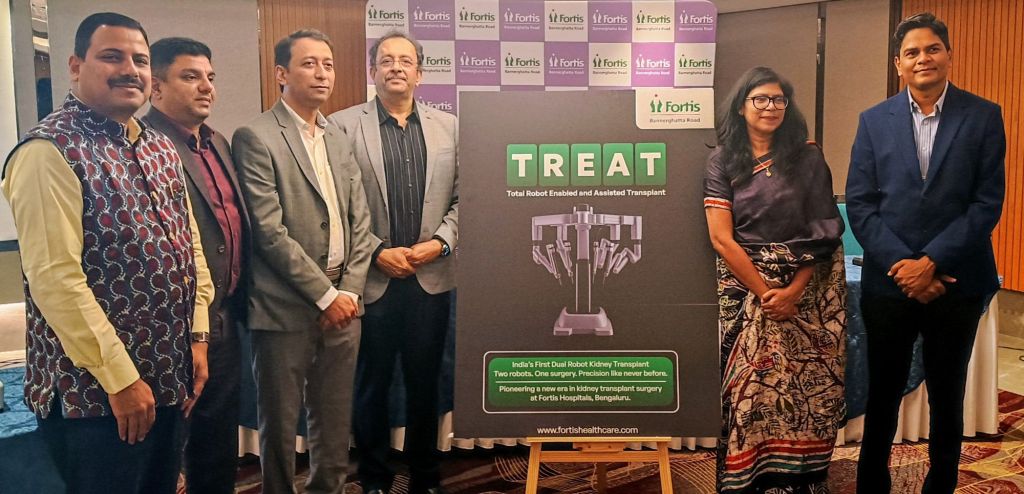
Bengaluru, June 26, 2025 — In a major medical milestone, Fortis Hospital on Bannerghatta Road has launched India’s first Total Robot Enabled and Assisted Transplant (TREAT) program, revolutionizing the landscape of kidney transplantation with fully robotic procedures for both donors and recipients.
The TREAT initiative combines advanced robotic technology with patient-centered surgical protocols, offering a minimally invasive alternative to traditional transplant surgeries. In a first-of-its-kind achievement in the country, Fortis successfully performed simultaneous robot-assisted surgeries on both donor and recipient, showcasing the potential of robotics to handle even high-risk and complex transplant cases.
Unlike conventional methods, the TREAT program utilizes two robotic systems concurrently, significantly reducing surgical trauma, shortening recovery times, and enhancing precision. This innovation also brings much-needed focus to the wellbeing of kidney donors—who in India are predominantly women juggling multiple responsibilities—by enabling faster recovery, reduced pain, and shorter hospital stays.
According to hospital authorities, the program is particularly beneficial for recipients with co-existing medical conditions such as obesity, heart disease, or a history of failed transplants, who were often considered unfit for surgery in the past.

Remarkable Recoveries under TREAT
One of the earliest beneficiaries of the program was 47-year-old Joachim, a Tanzanian national with advanced kidney failure and heart complications. After being turned away by multiple institutions, he underwent a robot-assisted transplant on May 19, 2025, with his brother Amodeus as the donor. Both recovered well, with the donor regaining mobility within 24 hours and the recipient’s kidney function improving almost immediately.
In another complex case, 35-year-old Sana from Bijapur, whose only donor—her brother Chand—was blood group incompatible, received antibody-reduction therapy followed by a dual robotic transplant on May 5. Both siblings showed strong post-operative recovery within a week.
Similarly, 59-year-old Chowdenahalli, suffering from end-stage kidney disease linked to diabetes and hypertension, underwent a successful transplant with his wife Leelavathi as the donor. Despite a high-risk profile, the robotic procedure enabled her discharge in four days, with the recipient’s kidney showing improvement soon after.
Clinical Experts Weigh In
Dr. Mohan Keshavamurthy, Principal Director of Renal Sciences at Fortis Bengaluru, described the TREAT program as a paradigm shift. “This approach addresses not just medical precision, but also the emotional and physical needs of donors—especially women—while expanding eligibility for high-risk recipients,” he said.
Dr. Ritu Garg, Chief Growth & Innovation Officer at Fortis Healthcare, noted that the program is not just about surgical innovation but also about restoring quality of life. “TREAT is a powerful example of how empathy and technology can converge to improve patient outcomes,” she said.
With the introduction of TREAT, Fortis Hospital, Bengaluru has positioned itself at the forefront of robotic transplant surgery in India, setting a new standard in both surgical care and compassion.
City Today News 9341997936

 City Today News