
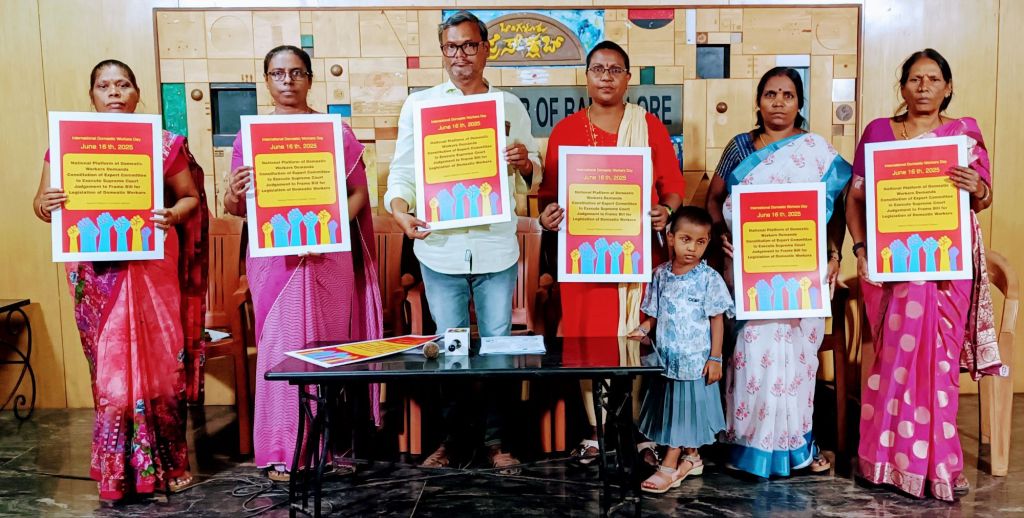
Bengaluru, June 6, 2025:
In light of the Supreme Court’s recent directive to enact a national law for domestic workers, the National Domestic Workers Movement (NDWM), Karnataka held a press conference at the Bengaluru Press Club, urging the central and state governments to take immediate action. The movement emphasized the urgent need for legislation to protect the rights and dignity of lakhs of domestic workers across the country.
Domestic workers, most of whom are women from underprivileged backgrounds, remain one of the most vulnerable and unrecognized labor groups. Employed in homes to cook, clean, wash clothes, and care for children and the elderly, these workers often face exploitative conditions, discrimination, and lack of basic labor protections.
“While we care for other people’s homes and families, our own lives are ignored by the system,” said Sahaya, a representative of the movement.
Harsh Realities Faced by Domestic Workers:
Over 90% of domestic workers are women and girls aged 12 to 65, many of them migrants from rural areas.
Workers are denied rest, access to toilets, proper food, or time off, especially those employed full-time.
Instances of verbal abuse, caste-based discrimination, and even false accusations of theft are common.
Migrant domestic workers are particularly isolated, often losing touch with their culture and language, and working in fear and silence.
Key Demands Presented by NDWM Karnataka:
1. Inclusion under Workplace Sexual Harassment Law
Tailored mechanisms to address harassment within private homes, as current district-level redressal systems are ineffective.
2. Access to ESI and Provident Fund
Like other formal sector employees, domestic workers should be covered under Employee State Insurance and PF schemes.
3. Enforcement of Minimum Wages
While minimum wage notifications exist, they are rarely enforced. The movement is also pushing for a living wage standard.
4. Paid Weekly Leave and Bonus
Most domestic workers do not receive weekly offs, paid sick leave, or annual bonuses, despite working long hours for low wages.
5. Protection Against Arbitrary Dismissal
Employers often terminate workers without notice or compensation. NDWM demands mandatory notice periods and severance pay.
6. Grievance Redressal Mechanism and Helpline
A dedicated helpline and complaints system should be set up to address grievances related to wages, abuse, and unfair treatment.
7. Legal Age Limit for Domestic Work
To curb child labor, the law should define a minimum legal working age for domestic workers.
8. End to Caste Discrimination
Many workers from Dalit and marginalized communities face segregation in utensils and are restricted to cleaning jobs. NDWM seeks legal protection against such practices.
9. Recognition as Formal Workers
Both domestic workers and employers should be registered with the Labor Department. Workers must be issued official ID cards.
10. Social Security and Pension
A dedicated Social Security Board for domestic workers is needed to ensure long-term welfare, including pension benefits.
11. Action Against Trafficking and Unregulated Placement Agencies
Many young girls are trafficked for domestic work. NDWM demands regulation and registration of all placement agencies.
12. Wage Revision and Overtime Pay
Employers rarely offer wage increases. NDWM urges the implementation of regular salary hikes and overtime compensation.
Addressing the media, representatives Shashikala, Bipin, Jabeena, and Karibasappa stressed that the Supreme Court’s recent direction offers a ray of hope—but only if backed by strong policy action and enforcement.
“The law must recognize the invisible hands that keep our cities running. It’s time domestic workers are treated with dignity, fairness, and respect,” the representatives said.
City Today News 9341997936
 City Today News
You must be logged in to post a comment.