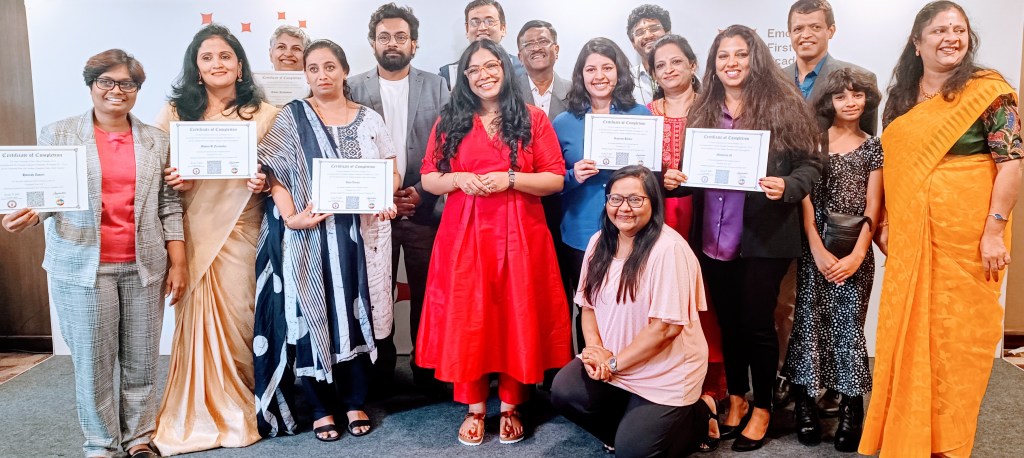
Bangalore, Nov. 25; The certificates will be issued at the convocation ceremony of Emotional First Aid Academy for those involved in mentally strengthening acid attack victims and thos e trained in extending mental wellness services, said Prof. Sunita K Mani, founder of the institute.
Addressing a press, she said that an interaction which was organised for the trainers at the Radison Blue hotel on Palace. This is an important area in the health sector. Nationwide, on an average about 800 people are subjected to acid attacks.
Trainers would be mentally strengthened and they work tirelessly like soldiers. The Academy is like a silver lining in the lives of acid attack victims, she said. for those involved in mentally strengthening acid attack victims and those trained in extending mental wellness services, said Prof. Sunita K Mani, founder of the institute.
L-R Dr. Chandrashekhar. S, Dr. Vineeta Shobha, Dr. K. m. Mahendranath & Dr. Vikramraj Jain
On 12th October every year, World Arthritis Day is celebrated to spread awareness about arthritis disease. Globally, about 1 in 4 people suffer from some form of arthritis. On this World Arthritis Day, we aim to spread awareness about chronic rheumatic diseases, their impact, and the measures one can take to prevent it.
When one thinks of arthritis, one usually envisions an old person with creaky joints. But that’s not always true. Majority of immune mediated arthritis affect young people in the 3rd and 4th decade of life. It used to be considered a crippling disease resulting in deformities till the end of last century. In today’s day and age, it is considered a chronic disease and a large majority of patients enjoy a good quality of life. One young family member in pain can pull down the morale of the entire family and put the entire family on the backfoot. Early initiation of effective treatment is the most important factor which can halt destructive joint damage.
Apart from the societal burden of arthritis, the financial burden of arthritis is mammoth. In a recent analysis carried out by members of Karnataka chapter of Indian Rheumatology Association(KRA), on an average, patients witha rheumatoid arthritis, spend about INR 60,000/- per year on their treatment. About two-third of this expense is related to medications alone. Also, one third of these patients spend more than 20% of their annual income for theira treatment which is largely, out- of -pocket. In the absence of recognition of these diseases by the Govt schemes and majority of insurance schemes, these illnesses continue to drain the family incomes.
Press meet held at Press Club of Bangalore
As a rheumatologist, our aim is to ensure that no or minimal damage is caused to the joints. This ensures not only lower financial burden, but also an good quality of life enjoyed by the patient and their family. This is very important from a societal perspective.
Meet a rheumatologist if you or your loved ones have aches and pains. The list of Rheumatology consultants available across Karnataka is available on the KRA website. (https://www.irakarnataka.org/) Reaching the ‘right specialist at the right time’ is the KEY to successful outcome.
Initiative launched on the occasion of JRD Tata’s birth anniversary
July 29, 2023 – Each year, on the occasion of JRD Tata’s birth anniversary, Tata Group companies come together to celebrate the legacy of the visionary leader. This year, Tata 1mg Labs is launching a crucial campaign to raise Anemia awareness in India and offer vital health support to those in need. As a tribute to JRD Tata’s unwavering commitment to a healthier nation, they will conduct 10,000 free Anemia tests for women and children, ensuring a better and healthier future for them. Anemia, a condition characterized by low hemoglobin levels, primarily caused by iron deficiency, poses a significant health challenge, leading to chronic weakness and fatigue. In India, a staggering 57% of women aged 15-49 years are anemic, forming a substantial proportion of the global Anemia-affected population. An alarming contributing factor to this issue is the lack of visibility of Anemia, especially among females. The Tata 1mg Labs Anemia Screening Campaign aims to build awareness about timely testing by conducting 10,000 free tests for women and children residing in underprivileged areas. The initiative will focus on early detection and timely medical intervention to combat Anemia’s detrimental effects on affected patients. To ensure the success and reach of this life-transforming campaign, Tata 1mg Labs will be joining hands with multiple NGOs. Through these partnerships, the Anemia screening tests will be conducted via a series of camps held over the next two quarters across multiple cities, bringing essential healthcare services closer to those in need. Gaurav Agarwal, Co-Founder, Tata 1mg, expressed his thoughts about the campaign, stating, “Anemia has emerged as a critical health concern for our nation. The Anemia rate among women and children in India surpasses the global average. By conducting these screening tests for the more vulnerable population and providing them with holistic treatment and prevention, we hope to make a tangible impact on the lives of 10,000 people.” The Tata 1mg Labs Anemia Awareness Campaign is a heartfelt tribute to the values cherished by JRD Tata, and it epitomizes the group’s commitment to giving back to society. Through this initiative, Tata 1mg Labs aims to contribute to a healthier nation, fulfilling its brand promise of making healthcare accessible, affordable and understandable, with utmost dedication and care. Source: NFHS-5 (2019-2021)
Dr A Arun Kumar, Senior Specialist – Vascular and Endovascular Surgery, Aster RV Hospital
Varicose veins are a common condition that affects the veins, usually in the legs, causing them to become enlarged, twisted, and bulging. They occur when the valves within the veins fail to function properly, leading to blood pooling and increased pressure within the affected veins. While varicose veins are often considered a cosmetic concern, they can also cause discomfort, pain, and other complications. Fortunately, various treatment options are available to manage and treat varicose veins effectively. Causes of Varicose Veins Age and Genetics As we age, the natural wear and tear on vein valves can lead to their dysfunction. Additionally, a family history of varicose veins increases the likelihood of developing this condition.
Prolonged Standing or Sitting Occupations that require long periods of standing or sitting can put additional pressure on the veins, hindering blood flow and increasing the risk of varicose veins.
Hormonal Changes Hormonal fluctuations during pregnancy and menopause can weaken vein walls and valves, making women more susceptible to varicose veins.
Obesity Excess weight puts added pressure on the veins, impairing their ability to transport blood efficiently and potentially leading to the development of varicose veins. When is procedure for Varicose Vein required? Treatment for varicose veins is typically recommended when the symptoms and complications associated with them become bothersome or when they significantly impact an individual’s quality of life. Some common indications for varicose vein procedures include: Pain and Discomfort When varicose veins cause persistent pain, throbbing, aching, or cramping in the legs, treatment may be advised to alleviate these symptoms.
Swelling and Inflammation Varicose veins can lead to swelling, inflammation, and a feeling of heaviness in the affected leg. Treatment may be considered to reduce these symptoms. Skin Changes Skin discoloration, rashes, dryness, and itchiness around the varicose veins can indicate the need for treatment to prevent further skin complications.
Ulcers and Bleeding In rare cases, varicose veins can develop ulcers or skin sores, which are often difficult to heal. Additionally, if the veins are prone to bleeding, medical intervention may be required.
Treatment options for Varicose Veins Several treatment options are available for varicose veins, depending on the severity and specific needs of the patient. These procedures aim to relieve symptoms, improve appearance, and prevent complications. Here are some commonly used treatments: Lifestyle Changes Simple lifestyle modifications such as regular exercise, maintaining a healthy weight, avoiding prolonged periods of standing or sitting, and elevating the legs can alleviate symptoms and prevent further progression.
Compression Stockings Wearing compression stockings provides external pressure that helps improve blood circulation and reduces discomfort associated with varicose veins.
Endo-venous Laser Ablation (EVLA) EVLA is a minimally invasive treatment that uses laser energy to heat and seal off the affected vein. It is effective for larger varicose veins can be performed under local anesthesia.
Radiofrequency Ablation (RFA) Similar to EVLA, RFA involves using heat energy to close off the damaged vein. A catheter with a radiofrequency device is inserted into the vein to achieve this.
Ambulatory Phlebectomy This surgical procedure involves making tiny incisions over the varicose veins and removing them through these small cuts. Ambulatory phlebectomy is suitable for larger varicose veins close to the surface of the skin.
Sclerotherapy This procedure involves injecting a solution directly into the affected vein, causing it to close and eventually fade away. Sclerotherapy is commonly used for smaller varicose veins and spider veins.
Remember, maintaining a healthy lifestyle, including regular exercise, maintaining a healthy weight, and avoiding prolonged periods of inactivity, can play a significant role in preventing or managing varicose veins. Taking proactive steps to care for your vascular health can go a long way in ensuring your overall well-being and quality of life
Peripheral neuropathy, also known as nerve damage, is a common condition that affects everybody at some point in their life and is characterized by the hallmark symptoms of tingling, numbness, pain, and muscular weakness. Several types of nerve injury fall under the umbrella category of neuropathy. The number of affected nerves can be used to classify all neuropathies; mononeuropathies impact only one nerve, whereas polyneuropathies affect many. They are further divided into categories based on the kind of nerves (motor, sensory, or autonomic) they mostly influence. Basics of peripheral neuropathy Your peripheral nervous system (PNS) is a critical component of almost every bodily function, from sensory perception and voluntary motor activities like muscle contraction to autonomic processes like digestion, body temperature control, heart rate, and blood pressure. Damaged peripheral nerves make it difficult for them to send and receive complete, coherent messages to and from your central nervous system. Physical trauma, an underlying medical condition, a vitamin deficiency, or exposure to poisonous substances are just a few of the many causes of harm. These nerves may deliver messages that aren’t correct, like static on a phone line, or they may give signals that are warped, like a wavering television image. They might even completely stop signaling, like a damaged line. In injury-induced neuropathy, nerve damage can appear suddenly, as is frequently the case, or it can appear gradually and worsen over time, as is frequently the case with diabetic neuropathy. Forms of neuropathy and symptoms Although the type and degree of the symptoms that neuropathy causes are frequently used to characterize it, the first classification of neuropathy is based on how many nerves it affects. There are two primary categories of neuropathy: Mononeuropathy One nerve or set of nerves is affected by mononeuropathy. This type of neuropathy can develop from prolonged nerve pressure brought on by spending too much time sitting in a chair or lying in bed, however it is frequently brought on by physical trauma or injury. Mononeuropathy can also occur as a result of persistent or repetitive movements, local compression, and chronic inflammation. The most prevalent type of mononeuropathy, carpal tunnel syndrome, generally manifests in just this way. Symptoms typically manifest locally and widely. When it affects the peroneal nerve below your knee, you may have lower limb weakness that makes it difficult to lift your foot. When it affects the ulnar nerve in your elbow, you may suffer numbness in your elbow and tingling in your ring and pinky fingers radiating from your elbow. Polyneuropathy The majority of the time, neuropathy affects many nerves and nerve types, leading to extensive peripheral nervous system dysfunction. This disorder, sometimes referred to as polyneuropathy, typically develops when several peripheral nerves break down simultaneously due to an underlying medical condition. Depending on the kind, location, and extent of the affected nerves, polyneuropathy symptoms can range from moderate and sporadic to severe and ongoing. Your reflexes and movement might be impacted by injury to your motor nerves, whereas your sensations and sense of balance can be impacted by damage to your sensory nerves. An erratic heartbeat, excessive perspiration, bowel and bladder issues, enduring gastrointestinal symptoms, and abrupt blood pressure swings that make you feel dizzy or lightheaded are all indicators of autonomic nerve injury. Options for treating neuropathy As the majority of peripheral neuropathies are incurable or irreversible, treatment focuses on slowing or halting disease development and delivering long-lasting symptom relief so you can resume your normal, active lifestyle. Keep your underlying medical condition under control if it’s diabetes that’s the root of your problem if you want to avoid more nerve damage. The majority of neuropathy cases react effectively to specific lifestyle adjustments; many patients discover that maintaining an active lifestyle, eating a healthy diet, and decreasing weight can all significantly reduce the severity of their neuropathy symptoms. Mechanical devices like braces, occupational therapy, and physical therapy are all beneficial.




 City Today News
You must be logged in to post a comment.