
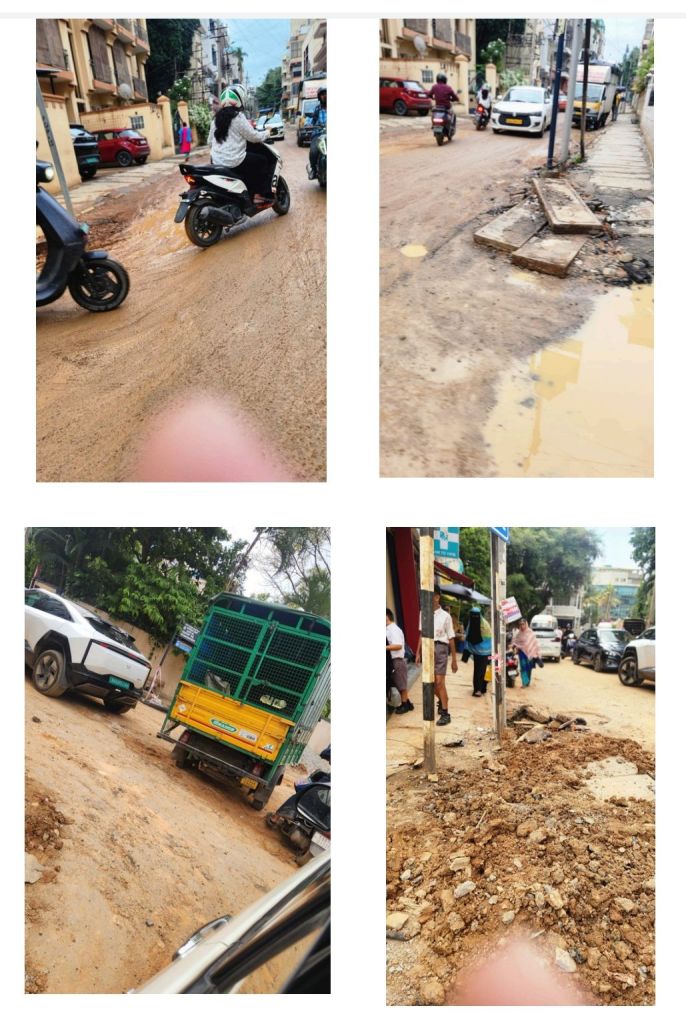
Bengaluru: The deteriorating condition of roads across Bengaluru, particularly in Richmond Town, has once again raised serious concerns over public safety, repeated road excavation and inadequate restoration during the monsoon season.

Dr. D. Kiran Jeevan, Founder of ‘Namma Roads Matter’, has urged the Greater Bengaluru Authority (GBA) to take immediate action to address the worsening condition of city roads and ensure accountability among civic agencies, utility providers and contractors responsible for road-cutting and restoration works.
In a representation addressed to the Commissioner of the Greater Bengaluru Authority, with a copy to Revenue and Bengaluru Development Minister Krishna Byre Gowda, Dr. Jeevan said several roads and internal streets in Bengaluru, including those in Richmond Town, have developed potholes, uneven surfaces, damaged stretches and poorly restored road-cuttings.
He pointed out that the situation becomes particularly dangerous during the monsoon, when rainwater collects on damaged road surfaces and conceals potholes and uneven stretches, increasing the risk to pedestrians, motorists and other road users.
According to Dr. Jeevan, the problem is not confined to Richmond Town. Bengaluru has been witnessing a recurring cycle in which roads are repaired, subsequently excavated for utility or infrastructure works, and then inadequately restored. The process is often repeated within a short period, raising questions about planning, coordination, supervision and accountability.
‘Why are the same mistakes repeated every year?’
Dr. Jeevan questioned why the civic administration continues to face the same road-related problems every monsoon despite the fact that Bengaluru’s rainy season is predictable.
He said road deterioration, waterlogging, potholes and hazards arising from road-cutting are foreseeable problems and should therefore be addressed through advance planning and coordinated civic management.
“Roads that are excavated, inadequately restored and subsequently filled with rainwater can pose a serious threat to public safety,” he said.
He recalled that he had raised similar concerns last year regarding the deterioration of Bengaluru’s roads during the monsoon and the consequences of repeated excavation and poor restoration. Despite the passage of another year, he said, substantially similar problems continue to be witnessed across the city.
Questions over responsibility and accountability
The civic campaign has also raised questions about the responsibility of various agencies involved in road-cutting and restoration.
Dr. Jeevan sought clarity on who authorises repeated excavation of roads, who coordinates such works, who supervises restoration and who certifies that a road has been restored to the required standard.
He also questioned who would be held responsible when a road deteriorates soon after repair, particularly when public money has already been spent on its restoration.
He said road excavation, wherever unavoidable, must be carried out only after proper planning, obtaining necessary permissions and putting adequate safety measures in place. The agency undertaking the work should also be required to restore the road properly within a clearly defined timeframe.
Earlier legal notice remains unanswered
Dr. Jeevan further stated that he had previously issued a legal notice concerning the condition of Bengaluru’s roads and related civic issues. According to him, the Greater Bengaluru Authority, formerly the Bruhat Bengaluru Mahanagara Palike (BBMP), has not yet provided a substantive response to that notice.
He said the continued absence of a detailed response was concerning, particularly when the civic issues raised earlier continue to persist.
Demands for immediate action
Dr. Jeevan has urged the Greater Bengaluru Authority to undertake a comprehensive inspection of Bengaluru’s roads, beginning with severely damaged stretches in Richmond Town.
Among his key demands are:
Identification of roads that have been repeatedly excavated, repaired and re-excavated, along with the reasons for such recurring works.
Identification of agencies, contractors and authorities responsible for road-cutting activities.
Verification of whether prescribed permissions and restoration conditions have been followed.
Fixing responsibility for roads that have been inadequately restored and subsequently deteriorated.
Preparation of a coordinated monsoon road-management plan to restrict avoidable excavation during the rainy season.
Ensuring coordination between civic agencies and utility providers before a recently repaired road is excavated again.
Making agencies undertaking road-cutting responsible for complete and durable restoration within a stipulated period.
Mandatory barricading, warning signs, adequate lighting and safe pedestrian access at roadwork sites.
Adoption of durable and scientifically appropriate repair methods instead of temporary patchwork.
Proper monitoring of road-cutting permissions and closure of such permissions only after satisfactory restoration.
A written explanation regarding the action taken on his earlier legal notice and the reasons for the delay in providing a substantive response.
A time-bound action plan for repairing damaged roads across Bengaluru, including Richmond Town.
‘Road safety cannot become a seasonal issue’
Dr. Jeevan said Bengaluru, as one of India’s leading metropolitan cities, requires road infrastructure and maintenance systems that match its importance.
“The recurring cycle of digging, patching, deterioration and digging again cannot be treated as normal civic administration,” he said, stressing that public safety cannot be compromised because of inadequate planning or lack of coordination between government departments, civic agencies, utility providers and contractors.
He said every road excavation has consequences for motorists, pedestrians, residents, emergency services and other road users. Since many of these risks are foreseeable, civic authorities have a responsibility to anticipate them and take preventive measures.
According to him, Richmond Town represents only one example of a wider problem affecting Bengaluru. The larger issue, he said, is whether the city has an effective system to prevent the same roads from repeatedly becoming hazardous every monsoon.
Dr. Jeevan urged the Greater Bengaluru Authority to treat the representation as an urgent public-safety matter and take immediate, visible and sustainable measures to improve Bengaluru’s roads, beginning with the severely affected stretches in Richmond Town.
He also sought a written response detailing the corrective measures proposed, the agencies responsible for implementation and the timeline for completing the remedial works.
Dr. D. Kiran JeevanFounder, Namma Roads Matter – Civic CampaignBengalurudkjprofessor@gmail.com
City Today News 9341997936


You must be logged in to post a comment.